
Instagram Carousel Promotion for Indian Online Tutors
An effective Instagram carousel for an online tutor should teach one useful idea in a sequence that is easy to follow. Start with a specific learner problem, explain the idea, show an example, add a small practice task and end with one relevant next step. Promote the finished post only after the lesson and offer are clear.
For Indian tutors, localisation comes from the learner’s context, not from adding a flag to generic advice. A Class 10 mathematics tutor, an IELTS coach and a working-professional coding instructor serve different needs. Choose one audience, one level and one result for each carousel.
Pick one learner problem
A carousel becomes difficult to use when it tries to cover an entire subject. Choose a problem that can be explained in a few connected slides. Examples include one algebra error, one pronunciation contrast, one spreadsheet shortcut or one exam-planning habit.
Write the learner in plain terms: “CBSE Class 10 students revising quadratic equations” is clearer than “students.” For a professional course, define the role or experience level. Avoid claiming that one post will guarantee marks, admission, a job or an exam result.

Plan the slides before designing them
Use a simple teaching sequence. The first slide makes a clear promise. The next slides deliver the explanation and example. The final slide asks for one appropriate action, such as saving the lesson, trying a question, booking an assessment or reading the course details.
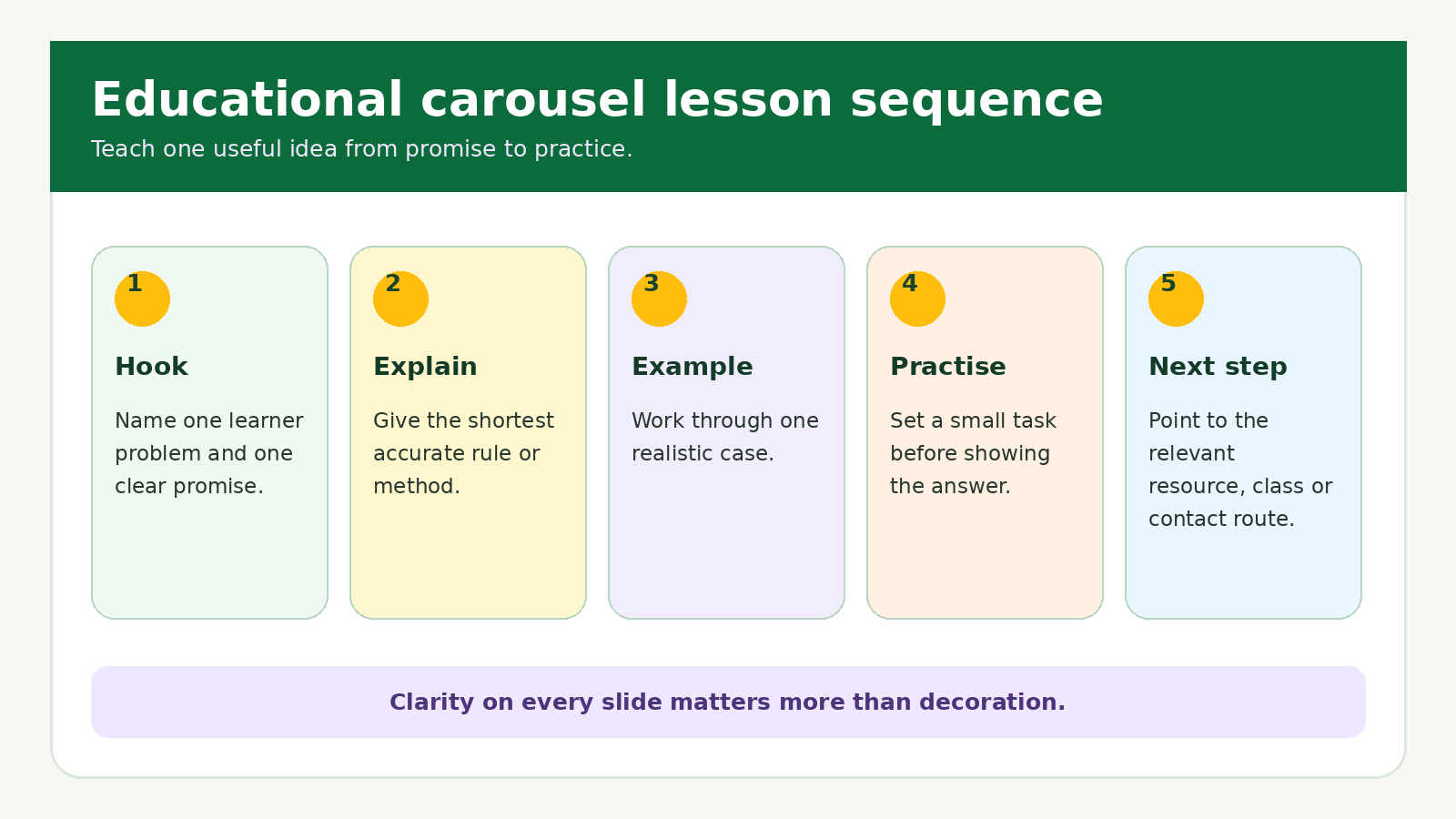
A five-part carousel structure
- Hook: name the exact mistake, question or skill.
- Explain: give the shortest accurate rule or method.
- Example: work through one realistic case.
- Practise: give the learner a small task before revealing the answer.
- Next step: point to the relevant class, resource or contact route.
Keep the text large enough to read on a phone. Use one visual hierarchy, consistent margins and high contrast. If a slide needs a long paragraph, simplify the explanation or move the detail into the caption. Accessibility matters more than decorative complexity.
Localise the lesson without narrowing it carelessly
Use examples that match the learner’s curriculum, exam, profession or daily experience. A tutor can mention rupees in a percentage question, Indian Standard Time in a scheduling example, or a familiar academic term when it genuinely helps the lesson. Do not imply that every Indian learner follows the same board, speaks the same language or has the same budget.
If you offer classes in more than one language, state which language the carousel and class use. For nationwide programmes, make time zones, class dates and device requirements clear. For a local programme, include the city only when location actually affects attendance.
Publish a caption that completes the lesson
The caption should add context rather than repeat every slide. State who the lesson is for, summarise the method and explain the next step. If you are accepting enrolments, give the course level, format, start date and contact process. If fees are shown in INR, make clear what the amount covers and whether taxes or materials are separate.
Use a question only when you are ready to answer it. “Which step was hardest?” can invite useful replies. A vague request for comments may create activity without helping learners. Moderate questions and correct misunderstandings politely.
Decide whether paid engagement fits the post
A paid like is a post-level engagement action. It is not a course enquiry, a student, a testimonial or an enrolment. It cannot prove that someone completed the lesson. If you use a social media marketing service, report its delivery separately from organic saves, direct messages, assessment bookings and payments.
Boostrify’s service guide directory explains that likes, comments, views and other actions can require different destinations, and that an audience label is separate from payment currency. Before choosing any option for an India-focused campaign, confirm that the current listing actually states the audience you need, accepts the exact post link and displays terms you understand. Do not infer Indian targeting from a rupee example in your content.
Instagram’s Community Guidelines ask users to foster meaningful and genuine interactions and warn against artificially collecting engagement. That creates a policy risk which should be considered before any purchase. No provider can guarantee recommendation, reach, account safety or enrolments.
Use a careful ordering checklist
- Publish the final carousel and open the public post link.
- Check every slide for factual, spelling and answer-key errors.
- Confirm the selected service action, audience label and required destination.
- Review the quantity, final displayed currency and dashboard charge.
- Keep the post public and avoid changing its link while delivery is active.
- Save the order ID and report the delivery separately from teaching outcomes.
Boostrify’s current terms say not to place duplicate orders for the same link while an order is active. They also explain that orders may take up to 72 hours to begin, timing can vary and engagement is not guaranteed to remain permanently. Read the selected service description because individual conditions may differ.
Measure what matters for a tutor
Use three columns in your campaign report. The first records content quality: topic, slide completion and learner questions. The second records promotion delivery: service, order ID, quantity and status. The third records business results: genuine enquiries, assessment bookings, trial-class attendance and paid enrolments.
This separation prevents a large like count from being presented as student demand. Compare the carousel with your own recent posts, but do not treat one post as a controlled experiment. Topic difficulty, timing, existing audience and the offer can all affect the result.
Common mistakes to avoid
- Teaching several unrelated ideas in one carousel.
- Using tiny text or crowded screenshots.
- Hiding important course conditions until a learner sends a message.
- Calling purchased likes students, leads or testimonials.
- Assuming audience location from currency or language.
- Promising exam marks, jobs or enrolments from a post.
A practical next step
Draft the five-slide lesson in plain text, test it with one learner, and correct any confusing step before design. Publish only when the caption and offer match the lesson. If you then consider paid promotion, compare the currently available Boostrify guides, verify the country label and destination in your account, and keep promotional delivery separate from genuine learning and enrolment results.
