
X Spaces for Nigerian Experts: A Practical Hosting Checklist
An effective X Space needs one clear promise, a short speaker plan and active moderation. Decide what listeners should understand by the end, invite people who can answer that question, and give every segment a time limit. Promotion can help people discover the session, but it cannot replace a useful conversation or guarantee attendance, leads or sales.
For Nigerian consultants, coaches and expert-led brands, this format works best when the topic is narrow. “How small retailers can price delivery in Lagos” is easier to follow than “business growth.” The narrower promise also makes your announcement post, speaker invitations and follow-up content easier to write.
Start with one listener promise
Write one sentence that completes this thought: “By the end of this Space, a listener will be able to…” If the sentence contains three or four outcomes, reduce the scope. A focused 35-minute session is usually more useful than a long conversation that keeps changing direction.
Turn the promise into a descriptive title. Avoid claims such as “guaranteed clients” or “the only strategy you need.” A credible title names the audience, problem and practical benefit. For example: “A simple invoice and payment workflow for Nigerian freelancers.”
Choose roles before you invite speakers
The host owns the flow. A co-host can watch requests, remove disruptive speakers and step in if the host loses connection. Each guest should have a reason to be there, such as direct experience, a useful counterpoint or a clear case example. Do not invite five people who will repeat the same advice.
- Host: opens the room, states the promise and moves the discussion forward.
- Co-host: watches the room, manages speakers and keeps an eye on time.
- Guest speakers: answer assigned questions with specific examples.
- Note-taker: records useful points and questions for the follow-up post.
X says Spaces are public, and people with protected posts cannot create one. Hosting is available on the iOS and Android apps, while people can listen on the web. Check the current X hosting instructions before the event because feature details can change.
Build a short run of show

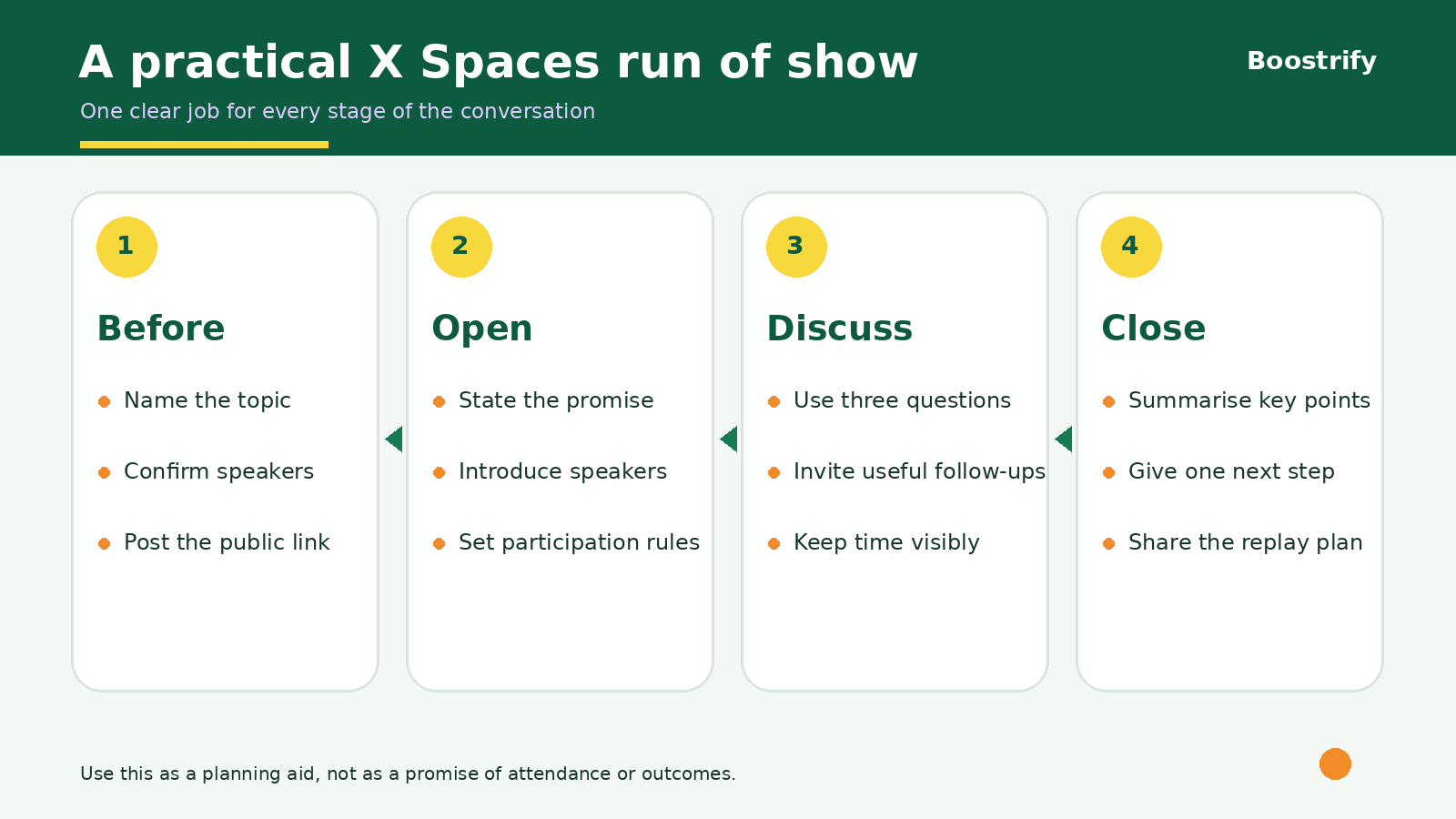
A run of show is a simple sequence that tells everyone what happens next. It does not need to sound scripted. It should prevent avoidable confusion.
- Opening, 3 minutes: welcome listeners, state the promise and introduce the speakers.
- Context, 5 minutes: explain the problem and define any unfamiliar term.
- Main discussion, 20 minutes: ask three prepared questions and one follow-up for each.
- Audience questions, 7 minutes: choose questions that add something new.
- Close, 3 minutes: summarise two useful points and give one relevant next step.
Promote the session in three stages
First, publish the scheduled Space link with the topic, date, West Africa Time and speaker names. Second, post a reminder that adds value instead of repeating the same artwork. You can share one question the speakers will answer or a short fact that explains why the topic matters. Third, post a final reminder shortly before the session for people who already showed interest.
Ask speakers to share the public link in their own words. Do not organise copy-and-paste posts from many accounts or ask people to create artificial reactions. X’s authenticity policy prohibits inauthentic activity that manipulates the platform.
Where Boostrify can fit, and where it cannot
Boostrify’s current service catalogue includes X services and Nigeria-labelled audience options. One listed option is a Nigeria-labelled X Space likes service. A catalogue label is not a promise of listeners, qualified leads, conversation quality or compliance with X rules.
Read the exact service description before ordering. Use only a service that fits your purpose and the platform’s current rules. Boostrify’s terms say users are responsible for platform compliance, profiles must be public for orders, duplicate orders should not be placed on the same link while one is active, and an order may take up to 72 hours to begin. “Instant start” describes the start condition of a specific service, not instant completion.
Moderate the live conversation
Open with participation rules. Tell listeners whether audience questions will be taken and when. Keep microphones muted when speakers are not talking. If a speaker drifts away from the topic, summarise their useful point and move to the next question. If someone is abusive, deceptive or repeatedly disruptive, remove them instead of debating them.
Plan for weak connectivity. The host and co-host should both have the speaker list, questions and closing note. If the host drops, the co-host can maintain the flow. Keep a separate message channel for essential coordination, but do not let private chat distract from the public discussion.
Turn the Space into useful follow-up content
Within a day, publish a concise recap with three points, one quote that the speaker has approved and the relevant next action. Do not present an edited quote as if it were the speaker’s exact wording. If a recording is available, listen again before writing a summary.
One Space can produce a recap thread, a short video explaining one answer, a checklist and a future topic based on an unanswered question. These are editorial possibilities, not guaranteed growth tactics. Choose the format that helps your audience use the information.
A worked example for a Nigerian consultant
Imagine a tax consultant hosting “What Nigerian freelancers should prepare before year-end filing.” The host invites one accountant and one freelancer who can describe the documents they keep. The three main questions cover records, common mistakes and when to seek professional help. The closing action points listeners to a free document checklist, not a hard sales pitch.
The next day, the consultant posts five takeaways and answers one question that could not fit into the live session. That follow-up gives late readers a useful entry point even if they never attended the Space.
Common mistakes to avoid
- Choosing a broad topic that produces vague answers.
- Inviting speakers without confirming their role and available time.
- Promising results that a live conversation cannot guarantee.
- Buying or coordinating activity without checking X’s current rules.
- Ending without a summary or a relevant next step.
Start with the listener promise, then build the session around it. When the room, speakers and follow-up are ready, you can compare Boostrify’s current X service options and decide whether any specific service fits your plan and the platform rules.
