How to Manage YouTube Comments for a Nigerian Channel
Good YouTube comment moderation starts before a video receives attention. Choose your comment settings, prepare blocked words and link controls, decide who will review difficult messages, and write a simple response standard. Comments can help a Nigerian channel learn from viewers, but a larger comment count does not prove trust, customer satisfaction or community quality.
Boostrify currently lists Nigerian YouTube video comments for a published video. The page says the option concerns video comments, not live chat, subscriptions or reviews. You must confirm whether the selected service supplies the text or expects your wording, and you should review YouTube's platform rules before deciding to order.
Set the channel rules first
Write a short moderation policy for your team. Allow disagreement and genuine questions, but remove or report threats, scams, impersonation, personal information and prohibited content. Decide how you will handle off-topic promotion, repeated messages and links. This keeps decisions consistent when a video becomes busy.
YouTube's channel moderation guidance says creators can manage comment, live chat and Community settings in YouTube Studio. Available controls include holding comments for review, blocking words and holding comments or posts that contain links. Use the controls that match your channel's risk and the time you can spend reviewing.

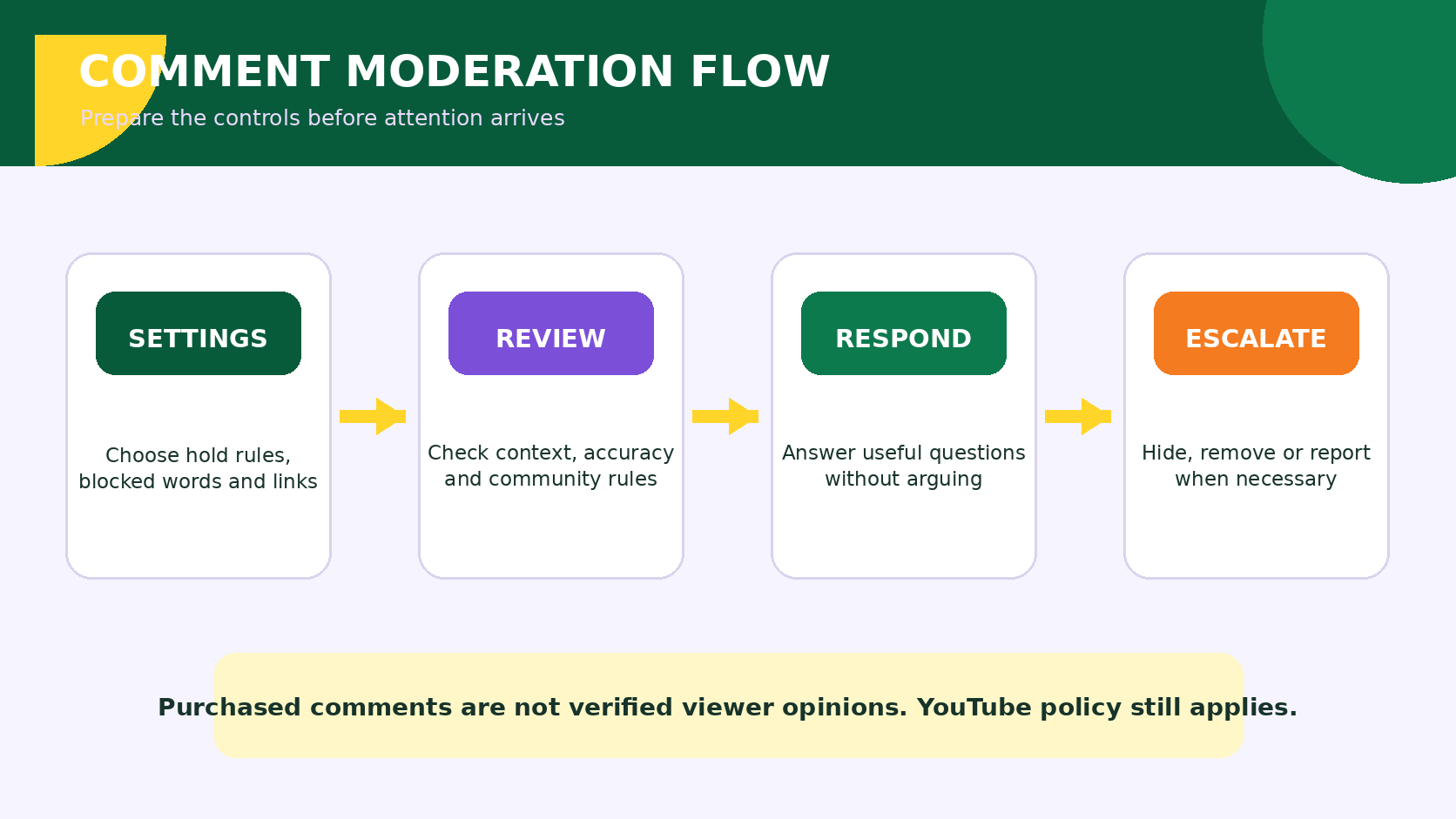
Use a four-stage moderation flow
1. Configure the settings
Choose the default setting for new uploads and check the setting on each important video. Add blocked words that are clearly harmful or repeatedly abused on your channel. Consider holding links for review because misleading links can put viewers at risk. Keep the list focused so legitimate discussion is not hidden unnecessarily.
2. Review the message in context
Read the comment beside the video and the surrounding conversation. A short sentence can mean something different when it replies to another viewer. Check whether it contains a genuine question, criticism, misinformation, spam or a safety concern. Do not remove a difficult but relevant question simply because it is uncomfortable.
3. Respond with a useful answer
Answer factual questions clearly. Correct your own mistake when necessary. For a business channel, move account-specific or payment details to a secure support route without asking the viewer to post private information publicly. Avoid long arguments. One calm answer can be more useful than ten defensive replies.
4. Escalate when the risk is real
Hide, remove or report content when it breaks your rules or YouTube's policies. Keep a record when a threat, impersonation attempt or serious allegation needs further review. If several people manage the channel, define who can make the final decision.
Prepare comments that do not mislead viewers
If a service accepts custom wording, every line should be relevant to the actual video. Avoid invented customer experiences, fake endorsements, false claims and comments that pretend a person bought a product or attended an event. Do not include phone numbers, email addresses or sensitive personal details.
Use natural variety without manufacturing a false story. A comment can ask about a point mentioned in the video or reflect the topic, but it should not claim first-hand experience that did not happen. Purchased comments are not verified viewer opinions and must not be presented as testimonials.
Understand the platform-policy risk
YouTube's fake engagement policy says the platform does not allow artificial increases to views, likes, comments or other metrics. It also warns that a promoter's actions can affect the channel. That means a third-party service description does not override YouTube's rules.
If the policy risk is unacceptable for your channel, do not buy comments. Use organic prompts, official advertising tools and normal community management instead. Boostrify's terms also state that users are responsible for complying with platform rules and accept the risks associated with their orders.
Ask questions that invite genuine discussion
A useful prompt should connect directly to the video. A finance educator might ask which part of a budget was hardest to understand. A filmmaker might ask viewers which lighting example looked clearest. A product tutorial can ask what step needs a separate demonstration.
Avoid repetitive engagement bait. Do not demand a comment unrelated to the content or offer misleading rewards. The goal is to learn from viewers and help them continue the conversation, not merely to increase a number.
Create a simple response standard
| Comment type | Recommended action | Reason |
|---|---|---|
| Useful question | Answer or direct to a verified resource | Helps the viewer and future readers |
| Respectful criticism | Acknowledge and correct facts where needed | Supports honest discussion |
| Repeated promotion or irrelevant links | Hold, remove or mark as spam | Protects the conversation |
| Threat, scam or impersonation | Document and report | May require platform action |
Check the video before a campaign
Open the exact published video and confirm comments are available. Check the title, description, audience setting and visibility. Use the video URL required by the service, not the channel homepage. Review any supplied or custom text before submission and confirm that it does not include claims you cannot support.
Read the selected listing for its audience label, minimum and maximum quantity, final cost, delivery notes and refill conditions. Boostrify's terms say profiles must be public, duplicate orders should not be placed on the same link while an order is active, and the target link or ID should not be changed during delivery.
Measure discussion quality, not only volume
Separate purchased comments from organic responses. Record genuine questions, useful corrections, recurring concerns and requests for another video. Track whether viewers visit a linked resource or contact the business through the approved route. A smaller discussion can be more valuable when it reveals what the audience actually needs.
Review your moderation workload too. If one upload attracts repeated spam, improve the blocked-word list or link controls. If many questions repeat, add an answer to the description, a pinned comment or a follow-up video.
Build a channel people can talk to
Start with clear rules, sensible settings and a response process your team can maintain. Invite genuine questions and treat criticism fairly. If you still consider a comment service, compare the current Boostrify options with YouTube's policy and use only a small eligible test you can monitor.
Comment moderation is not only about removing bad messages. It is how you protect viewers, answer useful questions and keep the conversation connected to the value of the video.
