
YouTube Premiere for South African Indie Filmmakers: A Launch Checklist
A YouTube Premiere works best when the film is ready, the public watch page has a clear promise and somebody is assigned to moderate the live chat. Schedule the event early enough to test the final file and share the watch-page link. Treat the Premiere as a coordinated screening, not as a guarantee of views, press coverage, festival selection or revenue.
For a South African indie film team, the launch plan should separate three jobs: delivering the correct film, helping the right audience understand why it matters, and managing the live conversation. One person can hold more than one role, but each job still needs an owner.
Lock the film and the watch-page promise

Confirm the final export, title, thumbnail, description, credits, subtitles and rights information before you schedule the Premiere. Watch the exported file from beginning to end. Check dialogue, music, colour, end credits and any content warning. A last-minute replacement can create confusion across the team and audience.
Write one sentence that tells viewers what they are about to watch. For example: “A 24-minute documentary following three informal traders rebuilding after a market fire.” This is more useful than “our biggest film yet.” Add the director, production company, language and subtitle details where relevant.
YouTube’s Premiere guidance says scheduling creates a public watch page that can be shared before the event. Viewers can set reminders, comment and use live chat. After the Premiere, the video remains on the channel as a regular upload.
Assign a small launch team
- Publisher: owns the upload, metadata, visibility and final checks.
- Director or host: welcomes viewers and adds useful context in chat.
- Moderator: watches live chat, handles spam and escalates problems.
- Communications lead: shares the correct watch-page link and answers press or partner questions.
- Technical backup: keeps a copy of the final file, artwork and written launch details.
Put the watch-page URL, start time in South African Standard Time, credits and emergency contact route in one shared document. Avoid sending several similar links in different group chats.
Use a seven-day countdown plan
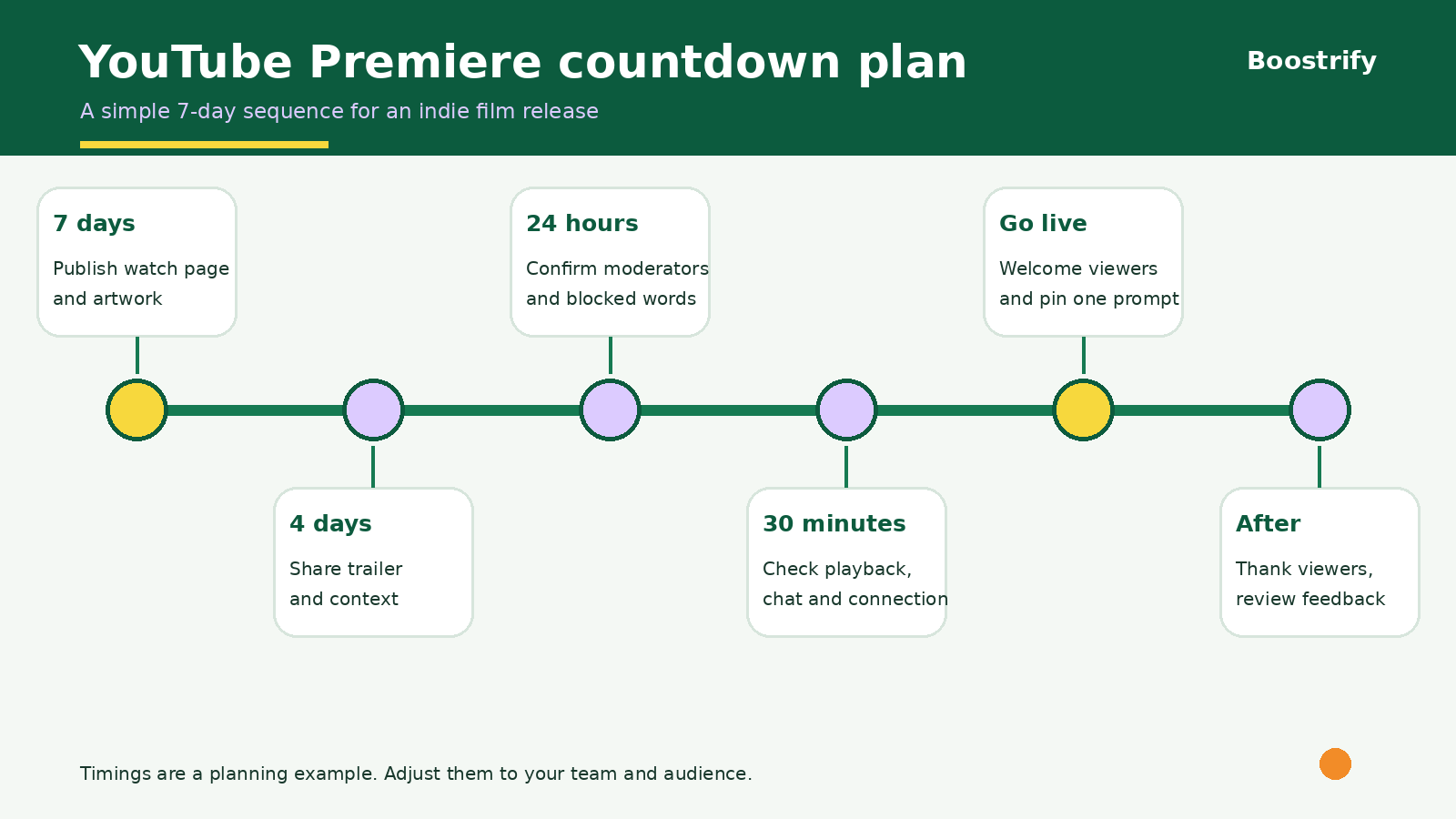
Seven days before
Publish the watch page after the final file has processed and the metadata has been checked. Share the link first with cast, crew, partners and people featured in the film. Give them suggested context, not a compulsory copy-and-paste caption.
Four days before
Post a trailer, still or short director note that gives people a reason to care. Match the material to the film. A documentary might use a question from the story; a comedy might use a character moment; a short drama might use a strong visual without revealing the ending.
Twenty-four hours before
Confirm the moderator, blocked-word list, description links and start time. Check that any age, music, sponsorship or rights information is accurate. Send a short reminder to people who already expressed interest.
Thirty minutes before
Check connection, power, logins and the live chat from a second device. The moderator should have the channel’s escalation rules and know who can make account-level changes.
Prepare the live chat before viewers arrive
YouTube provides moderation options including moderators, blocked words, held messages and slow mode. Review the current live chat moderation instructions in YouTube Studio because settings and labels can change.
Decide what the team will do with spoilers, abuse, impersonation, hate speech and repeated promotional links. Pin one useful message, such as the film context or post-screening question. Do not fill the chat with repeated calls for likes and subscriptions. The director should contribute genuine context and answer selected questions after the screening.
Promote the Premiere without promising an audience
Start with people closest to the film: cast, crew, community organisations, schools, film clubs, local media and partner venues. Give each group the correct watch-page link and a reason the film may matter to its audience. A Johannesburg film society may need different context from a community organisation in Gqeberha.
Use the same title, date and time on all artwork. If the film is available worldwide, say so. If rights or funding conditions limit viewing, make the limit visible before people set reminders.
Boostrify’s catalogue currently shows YouTube services and one entry labelled for a South African audience. A country label describes the listed service; it does not guarantee viewers, watch time quality, comments, sales or festival attention. Open the South Africa-labelled YouTube entry and read its exact destination, quantity, timing and refill conditions before making any decision.
YouTube’s fake engagement policy prohibits artificial increases to views, likes, comments and other metrics, including activity arranged by someone a channel hires. If a promotion method conflicts with that rule, do not use it. Boostrify’s terms also place responsibility for platform compliance on the user.
Run the Premiere like a screening
Join early. When the countdown begins, welcome viewers and state what will happen after the film. During the screening, the host can add occasional production context without distracting from the story. The moderator should prioritise safety and clarity rather than trying to maximise message volume.
At the end, thank viewers, credit the team and invite one specific action. That might be a post-screening question, a link to the director’s notes or a request to share the film with an appropriate community. Avoid a list of five unrelated calls to action.
A worked example for a short documentary
Imagine a Cape Town team premiering a 20-minute documentary about community football coaches. Seven days before, it publishes the watch page and sends it to the featured clubs for accuracy. Four days before, it shares a 30-second coach introduction. The day before, it confirms two moderators and a short list of blocked terms.
During the Premiere, the director welcomes viewers, then lets the film lead. Afterward, one coach answers three prepared questions. The closing message links to a page that explains how viewers can contact the featured clubs. The team reviews audience questions the next morning and corrects any factual misunderstanding in a follow-up post.
Review the launch without inventing success
Record what actually happened: whether the correct film played, whether the chat stayed manageable, which questions returned, which partner links were used and what the team should change next time. Review available YouTube Analytics after enough time has passed, but do not turn one event into a universal benchmark.
Separate exposure from outcomes. A view does not prove that somebody finished the film, understood it, joined a mailing list or supported the project. If you report results to partners, label the metric, time period and source.
Common Premiere mistakes
- Scheduling before the final export and rights details are confirmed.
- Sharing several different links or time formats.
- Leaving live chat without a moderator or escalation plan.
- Using artificial engagement methods that conflict with YouTube rules.
- Ending the screening without a clear, relevant next step.
Build the launch around the film and the audience it can genuinely serve. Once the watch page, team and moderation plan are ready, compare the current Boostrify YouTube service listings only as a separate, rules-checked decision.
